Author: zuadmin

  • New NSSF Rates in Kenya Effective February 2026 Zuri HR Payroll Guide

    New NSSF Rates in Kenya Effective February 2026 Zuri HR Payroll Guide

    Kenya’s National Social Security Fund (NSSF) continues its phased implementation of the NSSF Act 2013, introducing new contribution limits effective 1 February 2026.

    These changes increase the pensionable earnings limits, meaning both employers and employees may see higher NSSF contributions depending on salary levels.

    For HR and payroll teams, it is important to understand how these changes affect payroll calculations and employee deductions.

    Background: NSSF Act 2013

    The NSSF Act 2013 transformed NSSF into a mandatory pension scheme designed to enhance retirement savings for Kenyan workers.

    Under the Act:

    • Total contributions equal 12% of pensionable earnings
    • 6% is contributed by the employee
    • 6% is contributed by the employer

    The implementation of the Act has been phased since 2023, gradually increasing the pensionable earnings limits each year.

    What Changes in February 2026

    Effective 1 February 2026, both the Lower Earnings Limit (LEL) and Upper Earnings Limit (UEL) will increase.

    Although the 6% contribution rate remains unchanged, the expanded earnings bands mean employees earning above the lower threshold will contribute more to NSSF.

    New NSSF Contribution Structure

    TierEarnings RangeEmployee (6%)Employer (6%)Total
    Tier IUp to KES 9,0005405401,080
    Tier IIKES 9,001 – 108,0005,9405,94011,880
    Total Maximum—6,4806,48012,960

    This means the maximum monthly NSSF contribution will increase to KES 12,960 (KES 6,480 each from employer and employee).

    How NSSF Contributions Have Increased Over Time

    The phased implementation has gradually increased contribution limits each year.

    YearLower Earnings LimitUpper Earnings LimitTotal Contribution
    20236,00018,0002,160
    20247,00036,0004,320
    20258,00072,0008,640
    20269,000108,00012,960

    This progression reflects the government’s goal of strengthening retirement savings through higher pension contributions.

    Impact on Employees’ Salaries

    The new NSSF limits will affect employees differently depending on their income levels.

    Example 1: Employee earning KES 50,000

    • Tier I: 6% × 9,000 = 540
    • Tier II: (50,000 – 9,000) × 6% = 2,460

    Total employee deduction = KES 3,000

    Example 2: Employee earning above KES 108,000

    • Tier I: 6% × 9,000 = 540
    • Tier II capped at 108,000: 5,940

    Total employee deduction = KES 6,480

    These examples illustrate how contributions increase for employees earning above the lower earnings limit.

    Implications for Employers

    The new NSSF rates have several implications for employers and HR teams.

    1. Payroll Adjustments

    Organizations must update payroll systems to apply the new lower and upper earnings limits.

    2. Budget Planning

    Employer contributions will increase for employees earning above the lower earnings limit.

    3. Employee Communication

    HR teams should inform employees about changes to their NSSF deductions.

    4. Compliance

    Accurate payroll deductions and timely remittance to NSSF remain essential to avoid penalties.

    What Employees Should Expect

    Employees should be aware that:

    • NSSF deductions may increase slightly depending on salary
    • Take-home pay may reduce marginally
    • Retirement benefits will improve over time due to higher contributions

    Employees are encouraged to review their payslips to confirm that deductions are applied correctly.

    How Zuri HR Helps Businesses Stay Compliant

    Changes in statutory deductions can make payroll management challenging for organizations.

    Zuri HR simplifies payroll compliance by:

    • Automatically applying updated statutory rates
    • Calculating NSSF contributions based on the latest limits
    • Generating compliant payslips
    • Integrating payroll with employee records and attendance

    With automated payroll calculations, organizations can ensure they remain compliant with Kenyan statutory requirements without manual updates.

    Conclusion

    The new NSSF rates effective February 2026 represent the next phase of Kenya’s pension reform, increasing retirement contributions and expanding pensionable earnings limits.

    While these changes may slightly increase payroll deductions, they strengthen long-term retirement benefits for employees.

    Organizations should review their payroll systems and ensure the updated contribution limits are applied correctly.

    Modern payroll systems such as Zuri HR help organizations automate statutory deductions and maintain compliance with evolving regulations.


  • Goal Cascading: Align Employee Goals With Corporate Strategy | Zuri HR

    Goal Cascading: Align Employee Goals With Corporate Strategy | Zuri HR

    Why Your Company’s Strategy Gets Lost in Translation

    Your leadership team has a clear strategy. Revenue needs to grow, customers need to be retained, costs need to be controlled, and employees need to perform.

    But can every employee explain how their daily work contributes to those goals?

    This is where many organizations face a strategy-execution gap. Leadership understands the company’s priorities, but those priorities don’t always translate into clear objectives for departments, teams, and individual employees.

    The result? Employees stay busy, but their work may not always move the organization toward its most important goals.

    Goal cascading helps close that gap.

    What Is Goal Cascading?

    Goal cascading is the process of breaking down high-level organizational goals into department, team, and individual employee goals.

    Think of it as:

    Corporate Strategy → Organizational Goals → Department Goals → Individual Goals → Business Results

    For example, an organization may set a strategic goal to:

    Increase customer retention by 15%.

    That goal can cascade into:

    • Customer Support: Reduce average response time to under two hours.
    • Support Team: Resolve 90% of customer issues within the agreed service level.
    • Individual Employee: Maintain a 95% first-response compliance rate.

    Now, employees can see exactly how their performance contributes to the company’s broader strategy.

    Why Goal Cascading Matters

    Without strategic alignment, departments can focus on their own priorities while losing sight of the bigger picture.

    Effective goal cascading helps organizations achieve:

    Greater clarity – Employees understand what is expected and why it matters.

    Better accountability – Managers and employees can track progress against measurable objectives.

    Improved engagement – Employees can see how their work contributes to meaningful business outcomes.

    Stronger execution – Corporate strategy becomes part of everyday work rather than remaining a leadership-level document.

    From Spreadsheets to Smarter Performance Management

    Managing organizational and employee goals through spreadsheets can become difficult as a company grows. Goals can become disconnected, progress updates can be missed, and leadership may struggle to see how teams are performing against strategic priorities.

    A modern performance management system can bring this process together.

    How Zuri HR Helps

    With Zuri HR’s Performance Management solution, organizations can create a more structured approach to employee goal setting and performance tracking.

    Managers can connect individual goals to broader objectives, monitor progress, and create greater visibility across teams.

    This creates a clear connection between:

    Business Strategy → Employee Goals → Performance → Business Results

    Instead of asking only, “What is this employee doing?”, organizations can ask the more important question:

    “How is this employee’s work contributing to what the business is trying to achieve?”

    Turn Strategy Into Action With Zuri HR

    A strategy only creates value when it is translated into action.

    Goal cascading gives employees the clarity, direction, and accountability they need to contribute to organizational success.

    With Zuri HR, you can bring goal setting and performance management into one structured platform—helping managers and employees stay aligned with what matters most.

    Ready to connect employee performance with your business strategy?

    Book a Zuri HR demo today.

  • Key Features to Look for in an Attendance and Leave Management System Zuri HR

    Key Features to Look for in an Attendance and Leave Management System Zuri HR

    Managing employee attendance and leave manually can slow down operations and lead to costly errors. In 2026, businesses need a smart attendance and leave management system to improve efficiency, accuracy, and compliance.

    If you’re still relying on manual processes, it may be time to upgrade.  10 Benefits of Using an Automated Attendance Management System

    1. Real-Time Attendance Tracking

    A modern system should allow employees to clock in using:

    • Mobile apps
    • GPS tracking
    • Biometric devices

    This ensures accurate data and eliminates time theft.

    Manual vs Automated Attendance System: Which Is Best for Your Business

    2. Automated Leave Management

    The system should streamline leave requests with:

    • Easy application process
    • Multi-level approvals
    • Real-time leave balances

    Zuri HR automates the entire workflow, reducing delays and confusion.

    How Leave Approval Workflows Simplify HR Operations in Kenya

    3. Payroll Integration

    Attendance and leave directly impact payroll. A good system should:

    • Calculate overtime and deductions automatically
    • Sync with payroll
    • Ensure compliance with PAYE, NSSF, and SHIF

    How to Process Payroll Using ZuriHR in Kenya

    4. Employee Self-Service Portal

    Employees should be able to:

    • Apply for leave
    • View attendance records
    • Access payslips

    Zuri HR provides a user-friendly self-service experience that reduces HR workload.

    5. Reporting and Insights

    Look for systems that offer:

    • Attendance reports
    • Leave trends
    • Absenteeism analysis

    These insights help managers make better decisions.

    6. Mobile Accessibility

    With remote and field teams across Kenya, mobile access is essential. Employees and managers should be able to manage attendance and approvals on the go.

    Why Zuri HR Stands Out

    Zuri HR offers a complete attendance and leave management system designed for Kenyan businesses.

    It combines:

    • Smart attendance tracking
    • Automated leave workflows
    • Payroll integration
    • Real-time reporting

    If you’re comparing options, start here:
    (Zuri HR )

  • Handling Earnings, Deductions, and Benefits in Payroll Using ZuriHR

    Handling Earnings, Deductions, and Benefits in Payroll Using ZuriHR

    In any payroll system, accurately managing earnings, deductions, and employee benefits is crucial for compliance, employee satisfaction, and financial transparency. ZuriHR is designed to make this process smooth and automated for businesses. In this article, we’ll walk you through how ZuriHR handles these components, ensuring accurate salary computations and statutory compliance.

    1. Adding and Managing Bonuses

    Earning can be added directly in ZuriHR during payroll processing.

    From the Employee Employee data → Earnings & Deductions module:

    • Select the employee or use the Bulk tool
    • Choose the earning type (e.g., commission, bonus ) and applicable period
    • Enter the amount, rate, percentage of basic pay

    ZuriHR automatically factors in the earning amount into gross pay and calculates accordingly. Under Setting → Payroll you can also label earning as taxable or non-taxable, depending on internal policies and regulatory requirements.

    2. Applying Deductions

    ZuriHR allows you to define and apply different types of deductions, both statutory and voluntary.

    Statutory deductions (automated in ZuriHR):

    • PAYE – Based on current KRA tax bands
    • NSSF – Tiered contributions
    • SHIF – Based on salary brackets

    Voluntary/custom deductions:

    • SACCO contributions
    • Staff loan repayments
    • Welfare or social fund contributions
    • Penalties or fines (if approved by HR policy)

    Each deduction entry is reflected in the payroll preview, with full breakdowns visible in the payslip and payroll summary.

    3. Managing Employee Benefits

    ZuriHR enables employers to offer a wide variety of benefits and track their monetary value across payroll cycles.

    Examples include:

    • House allowance
    • Medical cover (cash or reimbursed)
    • Transport allowance
    • Phone/internet allowance
    • Non-cash benefits (e.g., company car)

    ZuriHR calculates the taxable portion of each benefit based on KRA guidelines. All this is handled automatically.

    You can configure benefits under Settings →Payroll  Benefits , and apply them .

    4. Audit Trails and Compliance Reporting

    Every bonus, deduction, or benefit change in ZuriHR is logged in the system’s audit trail. This ensures transparency and traceability during internal audits or external reviews.

    Additionally, you can generate:

    • Benefit reports per  department
    • Deduction schedules for Advance Pay
    • Statutory summaries for KRA, NHIF, and NSSF

    These reports simplify monthly and annual compliance, especially for HR and finance teams managing large workforces.

    5. Payslip Transparency

    Employees can view a detailed breakdown of:

    • Earning earned
    • Total deductions
    • Benefits received (taxed and untaxed)

    This transparency builds trust and reduces payroll-related queries. Employees access their payslips via the self-service portal.

    Conclusion

    Handling earning, deductions, and benefits doesn’t have to be complicated. With ZuriHR,  businesses gain a powerful tool for automating these payroll components while ensuring compliance with all legal requirements. Whether you’re managing a startup or an established company, ZuriHR helps you pay your team accurately, fairly, and on time.

  • Common Payroll Mistakes Kenyan Businesses Make 2026 Guide Zuri HR

    Common Payroll Mistakes Kenyan Businesses Make 2026 Guide Zuri HR

    Payroll is one of the most important processes in any organization. Employees expect to be paid accurately and on time, while employers must comply with statutory regulations.

    In Kenya, payroll processing involves several deductions, including PAYE, NSSF, SHIF, and Housing Levy. Managing these calculations manually can be challenging, and even small errors can lead to compliance issues or employee dissatisfaction.

    Understanding common payroll mistakes can help businesses improve payroll accuracy and efficiency.

    1. Incorrect Statutory Deduction Calculations

    One of the most common payroll errors is incorrect calculation of statutory deductions.

    Employers must ensure that payroll deductions comply with Kenyan regulations, including:

    • PAYE income tax
    • NSSF contributions
    • SHIF deductions
    • Housing Levy contributions

    If these deductions are calculated incorrectly, organizations may face penalties or compliance risks.

    How to avoid it

    Using payroll software helps automate statutory calculations and ensures deductions are applied correctly.

    2. Manual Payroll Processing

    Many small and medium-sized businesses still process payroll using spreadsheets.

    While spreadsheets may work for small teams, they quickly become inefficient as organizations grow.

    Manual payroll processing often results in:

    • calculation errors
    • duplicate data entry
    • time-consuming payroll processing

    How to avoid it

    Automating payroll through an HR system significantly reduces errors and administrative workload.

    3. Late Payroll Processing

    Delays in payroll processing can damage employee trust and morale.

    Employees rely on timely salary payments for their financial obligations. When payroll is delayed, it can create dissatisfaction within the workforce.

    How to avoid it

    Payroll systems that automate calculations and reporting help HR teams process payroll faster and more efficiently.

    4. Poor Attendance Integration

    Payroll calculations should account for attendance data, including overtime, absenteeism, and shift schedules.

    Organizations that do not integrate attendance tracking with payroll may experience inaccurate salary calculations.

    How to avoid it

    Attendance management systems integrated with payroll ensure accurate salary calculations.

    5. Lack of Payroll Transparency

    Employees often want visibility into how their salaries are calculated.

    Without clear payslips or payroll breakdowns, employees may question deductions or salary calculations.

    How to avoid it

    Providing employees with digital payslips and access to payroll information improves transparency and trust.

    How Zuri HR Helps Businesses Avoid Payroll Mistakes

    Modern HR platforms such as Zuri HR help organizations reduce payroll errors by automating payroll processes.

    Zuri HR provides tools that allow businesses to:

    • automatically calculate statutory deductions
    • generate compliant payslips
    • integrate attendance with payroll
    • manage employee records in a centralized system

    By automating payroll workflows, organizations can improve accuracy and efficiency.

    Final Thoughts

    Payroll errors can create serious problems for businesses, from compliance risks to employee dissatisfaction.

    Understanding common payroll mistakes helps organizations improve payroll accuracy and maintain compliance with Kenyan regulations.

    Modern payroll platforms like Zuri HR allow businesses to automate payroll processing and avoid costly payroll errors.

    Important Links:

    Best Payroll Software in Kenya

    Kenya PAYE Calculator

    Payroll Deductions Guide

    How to Process Payroll in Kenya

  • Zuri HR Namibia: Simplifying HR and Payroll Management

    Zuri HR Namibia: Simplifying HR and Payroll Management

    As part of our expansion across Africa, Zuri HR is now serving businesses in Namibia, bringing modern HR and Payroll technology to organizations looking for a simpler way to manage their workforce.

    Zuri HR combines essential HR functions in one centralized platform while adapting payroll to the statutory requirements of the Namibian market.

    Everything Your HR Team Needs in One Platform

    Zuri HR helps businesses manage their day-to-day HR operations through:

    • Attendance Management – monitor employee attendance and working hours.
    • Leave Management – manage leave requests, approvals and balances.
    • HR Calendar – organize important employee activities and HR events.
    • Performance Management – manage employee reviews and performance tracking.
    • Employee Data Management – keep employee records accurate and accessible.

    Having these functions in one system reduces manual administration and gives HR teams better visibility over their workforce.

    Payroll Built for Namibia

    Payroll requirements vary from one country to another. That is why Zuri HR maintains a consistent HR experience while localizing payroll to the statutory requirements of each market.

    For Namibia, payroll supports key statutory requirements including NamRA and NSSF/Social Security.

    NamRA – Namibia Revenue Agency

    Zuri HR supports PAYE payroll processing in line with Namibia’s tax environment. Employers are required to deduct employees’ tax from remuneration and remit it to NamRA. NamRA also requires employers to submit payroll-related returns and provide employees with PAYE 5 tax certificates.

    This makes accurate payroll calculations and reliable employee records essential for businesses operating in Namibia.

    NSSF – Social Security

    Zuri HR also supports applicable Social Security contributions, helping businesses manage employee and employer obligations through the payroll process.

    Namibia’s Social Security framework requires eligible employees to be registered with the Social Security Commission, with contributions made by both employees and employers.

    One Platform. Localized Payroll. Smarter HR.

    With Zuri HR Namibia, businesses can manage attendance, leave, HR activities, performance, employee information and payroll from one platform.

    Our expansion into Namibia is part of Zuri HR’s wider vision to provide businesses across Africa with HR technology that combines consistent workforce management with payroll adapted to local requirements.

    Whether you operate a growing business in Namibia or manage teams across several African countries, Zuri HR helps simplify HR and payroll administration as your organization grows.

    Zuri HR Namibia

    Smarter HR. Simplified Payroll. Built for Africa.

    www.zurihr.com
    info@zurihr.com

  • Zuri HR Botswana:A Complete Solution for Modern HR Management

    Zuri HR Botswana:A Complete Solution for Modern HR Management

    As part of our expansion across Africa, Zuri HR is now serving businesses in Botswana, providing a centralized platform for managing essential HR operations and payroll.

    Our goal is simple: help businesses reduce manual HR work, improve employee management, and process payroll using requirements relevant to the Botswana market.

    Complete HR Management in One Platform

    Zuri HR brings essential HR functions together in one system:

    • Attendance Management – monitor employee attendance and working hours.
    • Leave Management – manage leave requests, approvals and balances.
    • HR Calendar – organize important employee and HR activities.
    • Performance Management – track employee performance and reviews.
    • Employee Data Management – maintain accurate employee information in one place.

    With these functions connected, HR teams can reduce reliance on spreadsheets and disconnected systems while gaining better visibility into their workforce.

    Payroll Designed for Botswana

    Payroll is different from country to country, which is why Zuri HR localizes its payroll functionality for each market.

    For Botswana, payroll supports PAYE requirements administered by the Botswana Unified Revenue Service (BURS).

    BURS requires employers to deduct PAYE from applicable employee remuneration and remit the tax to BURS. The applicable tax is determined using the official BURS tax tables, rather than applying one flat percentage to all salaries.

    Zuri HR helps businesses manage these payroll calculations while maintaining employee payroll records and generating the information needed for payroll administration and statutory reporting.

    BURS also provides specific payroll returns, including the ITW7A monthly PAYE remittance return and ITW10 annual PAYE return, making accurate payroll records an important part of the compliance process.

    One HR Platform. Localized Payroll.

    Zuri HR’s approach is to keep the core HR experience consistent while adapting payroll to each country’s requirements.

    For businesses in Botswana, this means managing attendance, leave, HR activities, performance, employee information and payroll from one platform while supporting the country’s PAYE environment.

    As Zuri HR continues expanding across Africa, we are building a platform that combines modern HR technology with locally relevant payroll capabilities.

    Zuri HR Botswana

    Smarter HR. Simplified Payroll. Built for Africa.

    www.zurihr.com
    info@zurihr.com

  • Zuri HR Tanzania: HR & Payroll Technology Built for Tanzania

    Zuri HR Tanzania: HR & Payroll Technology Built for Tanzania

    As part of our expansion across Africa, Zuri HR is now serving businesses in Tanzania, providing an integrated platform for managing HR operations and payroll from one centralized system.

    Zuri HR brings together essential HR functions while adapting payroll to the statutory requirements applicable in Tanzania, helping businesses reduce manual work, improve accuracy and manage their workforce more effectively.

    Complete HR Management in One Platform

    Zuri HR provides businesses with a consistent set of HR tools, including:

    • Attendance Management – monitor employee attendance and working hours.
    • Leave Management – manage leave requests, approvals and balances.
    • HR Calendar – organize important employee and HR activities.
    • Performance Management – track employee performance and reviews.
    • Employee Data Management – keep employee information accurate and accessible.

    Having these functions in one system gives HR teams better visibility while reducing reliance on spreadsheets and disconnected processes.

    Payroll Built for Tanzania

    While the core HR modules remain consistent across Zuri HR’s markets, payroll is localized to meet the statutory and tax requirements of each country.

    For Tanzania, Zuri HR supports payroll processes around key statutory requirements including:

    TRA – Tanzania Revenue Authority

    Zuri HR supports payroll tax calculations and reporting related to PAYE and Tanzania Revenue Authority (TRA) requirements, helping businesses manage employee tax obligations as part of their monthly payroll process.

    NSSF – National Social Security Fund

    Payroll also incorporates applicable NSSF contributions, helping organizations manage social security deductions and employer obligations alongside their regular payroll processing.

    NHIF – National Health Insurance Fund

    Zuri HR supports applicable health insurance contributions and payroll processing requirements, helping businesses maintain accurate employee deductions and payroll records.

    SDL – Skills Development Levy

    Zuri HR also supports the Skills Development Levy (SDL) as part of Tanzania’s payroll statutory processes, helping employers account for applicable statutory obligations.

    WCF – Workers Compensation Fund

    The platform also supports WCF-related payroll requirements. WCF contributions are an employer obligation and are not deducted from employees’ salaries. The Workers Compensation Fund provides compensation services for employees affected by work-related injuries, diseases or death.

    One Platform. Localized Payroll. Smarter HR.

    Zuri HR’s approach is simple: keep core HR management consistent while adapting payroll to the requirements of each African market.

    For businesses in Tanzania, this means managing attendance, leave, performance, employee data and payroll from one platform while supporting important local statutory requirements such as TRA, NSSF, NHIF, SDL and WCF.

    Our expansion into Tanzania is another step toward our vision of providing businesses across Africa with modern, reliable and locally relevant HR technology.

    Zuri HR Tanzania

    Smarter HR. Simplified Payroll. Built for Africa.

    www.zurihr.com
    info@zurihr.com

  • Zuri HR Uganda: Integrated HR & Payroll Solutions for Modern Businesses

    Zuri HR Uganda: Integrated HR & Payroll Solutions for Modern Businesses

    As part of its expansion across Africa, Zuri HR is now serving businesses in Uganda, providing an integrated platform for managing HR operations and payroll from one centralized system.

    Zuri HR combines essential HR functions with payroll designed to support Uganda’s local statutory requirements, helping organizations reduce manual processes and manage their workforce more efficiently.

    Complete HR Management in One Platform

    Zuri HR provides businesses with a consistent set of HR tools across its African markets, including:

    • Attendance Management – monitor employee attendance and working hours.
    • Leave Management – manage leave requests, approvals and balances.
    • HR Calendar – keep track of important HR activities and employee events.
    • Performance Management – manage employee reviews and performance tracking.
    • Employee Data Management – maintain accurate employee information in one centralized system.

    By bringing these functions together, HR teams can spend less time managing spreadsheets and disconnected systems and more time focusing on their people.

    Payroll Built for Uganda

    While the core HR modules remain consistent across Zuri HR’s markets, payroll is localized to reflect the statutory requirements of each country.

    For Uganda, Zuri HR’s payroll is designed around key payroll obligations including:

    URA – Uganda Revenue Authority

    Zuri HR supports Uganda’s PAYE calculations, helping employers calculate and manage employee tax deductions based on applicable PAYE rules. The Uganda Revenue Authority states that employers are responsible for withholding and remitting PAYE, with monthly returns and payments generally due by the 15th of the following month.

    NSSF – National Social Security Fund

    Payroll also incorporates applicable NSSF contributions, helping businesses manage employee and employer social security obligations as part of their payroll process. URA guidance confirms that the employee NSSF contribution is considered separately from PAYE calculations.

    LST – Local Service Tax

    Zuri HR also accounts for Local Service Tax (LST) within the Uganda payroll process. LST is deductible before computing PAYE, according to Uganda Revenue Authority guidance.

    This localization allows businesses in Uganda to manage payroll using calculations that reflect the country’s specific statutory environment.

    One Platform. Localized Payroll. Smarter HR.

    Zuri HR’s approach is simple: keep core HR management consistent while adapting payroll to the requirements of each African market.

    For businesses in Uganda, this means managing attendance, leave, performance, employee data and payroll from one platform while supporting important local payroll requirements such as URA, NSSF and LST.

    As Zuri HR continues expanding across Africa, our goal is to provide businesses with modern HR technology that is simple, scalable and locally relevant.

    Zuri HR Uganda

    Smarter HR. Simplified Payroll. Built for Africa.

    www.zurihr.com
    info@zurihr.com

  • Zuri HR Zambia: Powerful HR & Payroll Solutions Built for Zambia

    Zuri HR Zambia: Powerful HR & Payroll Solutions Built for Zambia

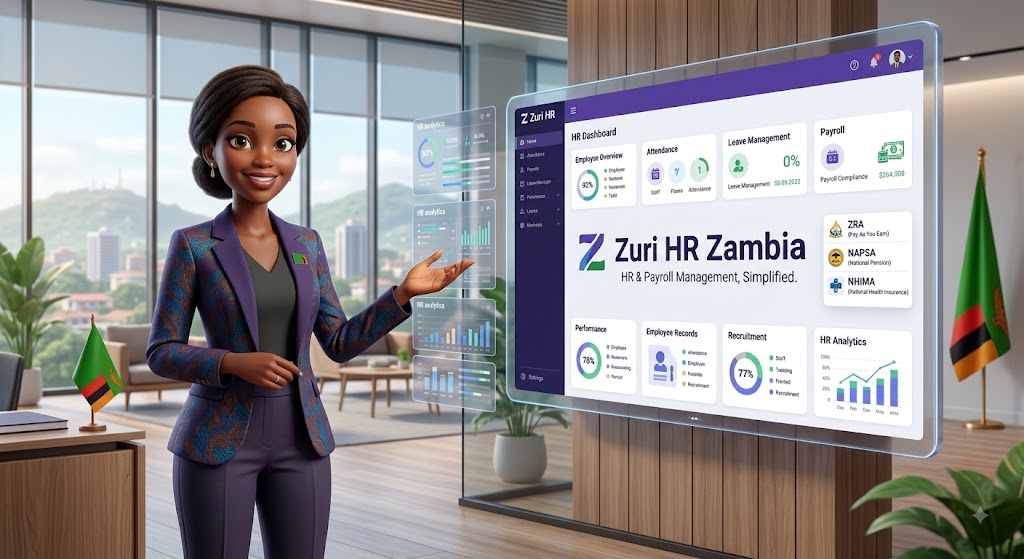
    As part of our expansion across Africa, Zuri HR is now bringing its integrated HR and Payroll platform to businesses in Zambia, helping organizations simplify workforce management while adapting payroll to Zambia’s statutory requirements.

    Complete HR Management in One Platform

    Zuri HR brings essential HR processes together in one centralized system, including:

    • Attendance Management – monitor employee attendance and working hours.
    • Leave Management – manage leave requests, approvals and balances.
    • HR Calendar – keep track of important employee and HR activities.
    • Performance Management – structure employee reviews and performance tracking.
    • Employee Data Management – maintain accurate employee information in one place.

    By bringing these functions together, Zuri HR helps HR teams reduce manual processes and improve visibility across their workforce.

    Payroll Built for Zambia

    While the core HR modules remain consistent across our markets, payroll is localized to meet the statutory requirements of each country.

    For Zambia, Zuri HR supports payroll processes around key statutory requirements administered by:

    ZRA – Zambia Revenue Authority
    ZRA administers PAYE, where employers calculate and deduct tax from employees’ employment earnings before remitting it to the Authority.

    NAPSA – National Pension Scheme Authority
    Zuri HR can support payroll calculations and reporting around NAPSA contributions. For formal-sector employees, NAPSA currently states that contributions are shared between the employee and employer.

    NHIMA – National Health Insurance Management Authority
    Payroll processing also accounts for applicable NHIMA deductions and reporting requirements, helping businesses manage their statutory payroll obligations from within their HR system.

    One Platform. Localized Payroll. Smarter HR.

    Zuri HR’s approach is simple: keep core HR management consistent while adapting payroll to the requirements of each African market.

    For businesses in Zambia, this means managing attendance, leave, performance, employee information and payroll from one platform while supporting Zambia-specific payroll requirements.

    As Zuri HR continues expanding across Africa, our goal is to give businesses modern HR technology that is simple, scalable and designed with local payroll requirements in mind.

    Zuri HR Zambia

    Smarter HR. Simplified Payroll. Built for Africa.

    www.zurihr.com
    info@zurihr.com