
What if payroll delays start before anyone calculates a salary? When attendance, leave, employee details and pay records sit in separate workflows, teams repeat data entry and reviews just to prepare a dependable payroll. For businesses looking for payroll management software Kenya, the goal is more than faster processing: it’s accurate records, clear deductions and payslips employees can access.
Manual checks can feel necessary when information is scattered, but they add steps to every pay cycle. A connected system brings relevant workforce data together, helping managers follow a consistent process and see which records support each payment.
This practical guide explains what payroll software does in a Kenyan business, which capabilities to assess for your workforce and pay cycle, and how integrated HR tools can support better operational control. It also covers how Zuri HR connects payroll with leave, time and attendance, and employee self-service. Employees can view payslips and request leave through the mobile app, while teams work from aligned information.
Key Takeaways
- See how payroll management software Kenya can organise recurring payroll tasks and connect employee records to payslips.
- Follow a practical payroll workflow, from maintaining employee details to reviewing inputs and giving staff access to payslips.
- Understand how software can organise statutory calculations and payroll records while keeping human review essential.
- Compare payroll tools by workflow fit, Kenyan payroll setup, employee access and reporting needs.
- Explore how Zuri HR connects payroll with leave, attendance and employee self-service in one cloud HR platform.
What payroll management software in Kenya does for a business
Payroll management software organises the recurring work of preparing employee pay, recording earnings and deductions, processing salaries, and distributing payslips. It gives payroll staff a structured way to manage the information and steps behind each pay cycle, instead of relying on scattered files and repeated manual entry.
For Kenyan businesses, payroll software turns employee pay information into organised salary records and payslips through a repeatable workflow. It helps a business manage payroll through software rather than providing an outsourced payroll processing service. Zuri HR offers payroll management software through subscriptions, giving businesses a platform to run their own payroll workflow.
Centralising employee details can reduce duplicate entry when information changes, such as an employee’s pay details or personal profile. It also makes it easier for payroll staff to see which records and inputs support a pay run. The broader What is Payroll? overview explains payroll as an essential business process. Software structures the records and actions involved in carrying it out.
Which payroll tasks can software organise?
A payroll cycle draws on employee records, pay details, earnings, deductions and relevant adjustments. Software brings these inputs into an organised workflow, helping payroll staff prepare salary processing and maintain records for each cycle. It can also distribute payslips, giving employees a record of their pay without requiring HR to handle every request manually.
Payroll reports provide structured information for administration and review. Teams can use them to inspect payroll results, follow up on discrepancies and retain a clearer record of each cycle. Software supports this work, but it cannot make inaccurate inputs correct. Payroll staff still need to review employee details, confirm relevant changes and approvals, and check outputs before finalising a pay run.
Why local payroll context matters in Kenya
A payroll system should reflect the Kenyan statutory requirements that apply to the employer and its workforce. Payroll teams may need to account for PAYE, NSSF, SHIF, the housing levy and NITA in their records and calculations. Requirements and their treatment can change, so businesses should use current authoritative guidance when reviewing their payroll configuration.
Local configuration matters because payroll software organises calculations using the rules and employee information set up in the system. A Kenyan-focused platform can support payroll workflows tailored to local requirements, but installing software alone does not establish that every calculation or record is correct. Review the configured rules, employee data and payroll outputs as part of regular oversight. This makes the system a useful administrative control while keeping people accountable for checking the information behind each cycle.
How payroll software connects employee data to payslips
A dependable payroll workflow starts with maintained employee records, not with the payslip. Payroll software can bring pay details and relevant workforce information into a sequence that authorised staff review before processing. Depending on the organisation’s processes and system setup, attendance, approved leave and shift information may also inform payroll preparation for the period.
Connected workforce data makes payroll easier to trace, from an employee record and reviewed input to the processed salary and payslip. That traceability depends on accurate information and clear review responsibilities. Software organises the workflow; people still check the inputs.
From employee records to a reviewed payroll run
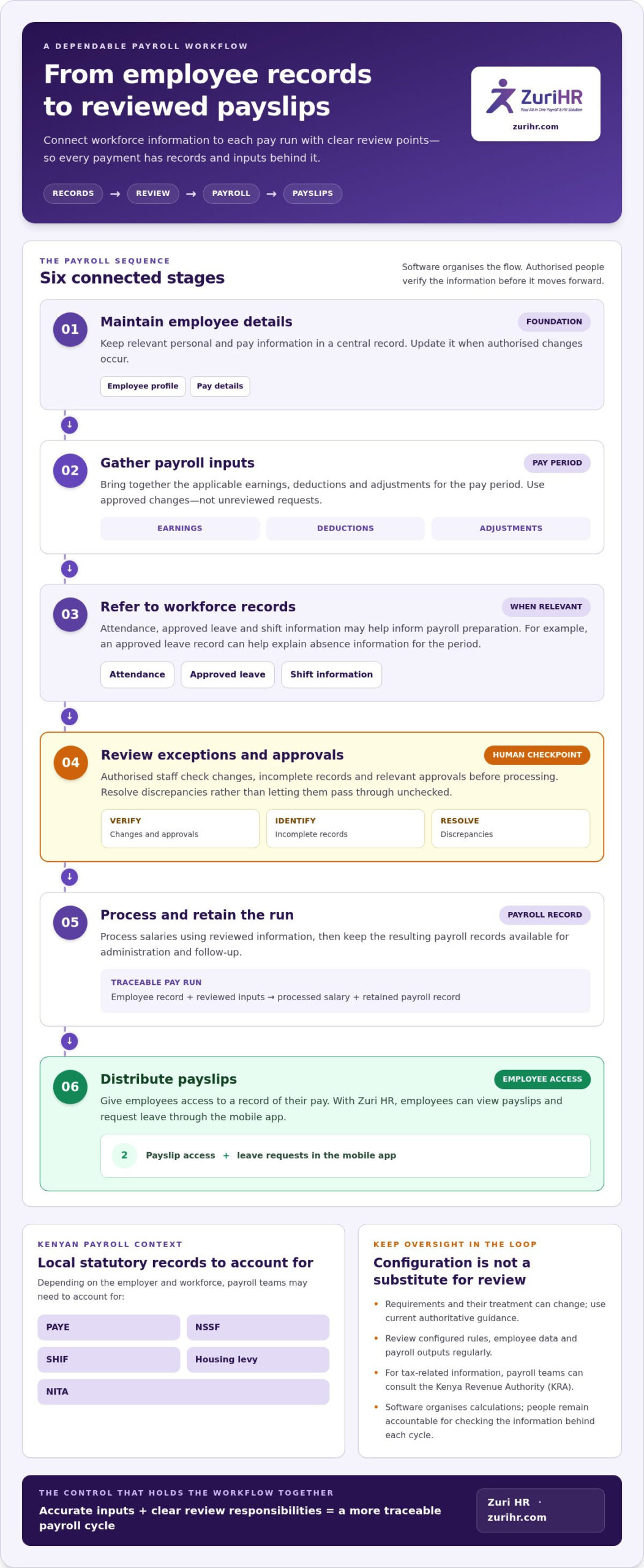
A practical sequence helps teams see where information enters the process and where a person must verify it. The steps below are illustrative. Align review and approval controls with your business’s payroll procedures.
- Maintain employee details. Keep relevant personal and pay information in a central record, and update it when authorised changes occur.
- Gather payroll inputs. Bring together applicable earnings, deductions and adjustments for the pay period. Use approved changes rather than unreviewed requests.
- Refer to workforce records. Attendance, approved leave and shift information may help inform payroll preparation. For example, a manager’s approved leave record can help payroll staff understand absence information for the period.
- Review exceptions and approvals. Authorised staff check changes, incomplete records and relevant approvals before processing. Resolve discrepancies instead of letting them pass through unchecked.
- Process and retain the run. Process salaries using the reviewed information, then keep the resulting payroll records available for administration and follow-up.
This sequence creates useful checkpoints. For example, record and review a change to an employee’s pay details before it affects a payroll run. For tax-related information, payroll teams can consult the Kenya Revenue Authority (KRA) as an authoritative reference, while also reviewing system inputs and outputs. Payroll management software Kenya businesses use should support this disciplined flow, not suggest that automation removes the need for oversight.
From payroll processing to employee self-service
Salary processing and payslip distribution are related but distinct steps. The business processes pay using reviewed information, then the system supports payslip distribution so employees can access their individual pay records. Direct staff access can reduce routine requests to HR and give employees a reference for their own records.
Zuri HR’s mobile employee self-service app lets staff view payslips, request leave and update personal profiles. This connects employee access with the wider payroll and workforce workflow, while authorised staff retain responsibility for payroll approvals. Zuri HR’s payroll and employee self-service platform brings these tools together.
How Kenyan payroll software supports statutory records and review
Payroll software can organise calculations, payslips, employee records and reports, but installing a system does not automatically make payroll correct or compliant. Results depend on the configured rules, the accuracy of employee information and the checks people perform before processing. Treat payroll management software Kenya businesses use as a control and recordkeeping tool, not a substitute for employer oversight.
For 2026 payroll, verify statutory names, rules, rates and reporting requirements against authoritative guidance. Payroll teams may encounter PAYE, NSSF, SHIF, NITA and the housing levy in their processes. Confirm which requirements apply and whether settings remain current using relevant official guidance, including the National Social Security Fund (NSSF) for NSSF information. A software label or old configuration is not proof that a calculation is correct.
What payroll teams should verify before processing
Use a consistent pre-processing review to reduce payroll errors in Kenya and identify gaps before payroll outputs reach employees or become part of the business record.
- Current rules: Check statutory settings against authoritative Kenyan guidance relevant to the payroll period. Verify applicable names, rates, rules and reporting requirements for 2026.
- Accurate employee data: Confirm that pay details, changes and other relevant inputs are complete, current and authorised.
- Human review: Assign authorised staff to inspect calculations and exceptions. Investigate unexpected changes rather than approving them automatically.
- Output comparison: Compare payroll results with internal employee and pay records. Resolve discrepancies before finalising processing and distributing payslips.
- Retained records: Keep relevant payroll outputs and supporting records in line with the organisation’s recordkeeping procedures and applicable requirements.
How software can make payroll records easier to review
A structured system brings payroll information into consistent records that are easier to inspect and follow up. Payslips show employee-facing pay information, while payroll reports give administrators a consolidated view of processed data. Reviewers can use these outputs to spot differences between a recorded input and a payroll result, then trace the issue back to the information that needs attention.
Consistency matters across pay periods. When teams keep records in a predictable format, they can compare outputs, locate information and document follow-up without rebuilding the review trail from separate files. Software supports that administrative discipline; it does not determine whether a legal requirement applies, provide legal advice or remove the employer’s responsibility to oversee payroll. Keep statutory settings under review and make people accountable for validating the records and decisions behind each run.
How to assess payroll management software for your organisation
Start with your payroll workflow, not a long feature list. Map where employee changes, pay inputs, attendance, leave, approvals, processing and payslip access happen today. Identify which steps create duplicate work or make review difficult. This gives you a practical basis for assessing payroll management software Kenya businesses can use, and helps separate essential capabilities from useful extras. For a direct comparison of approaches, see payroll software vs manual payroll for Kenyan businesses.
Match software capabilities to your payroll workflow
Define who prepares payroll, who reviews changes, who approves the run and who needs access to records. If attendance or approved leave affects payroll inputs, consider whether those records should sit alongside payroll information. Shift planning may matter for workforces with shift-based schedules, but it is not essential for every organisation. Prioritise capabilities that address actual hand-offs in your process.
Use this comparison framework to assess fit. Evaluate each point against your organisation’s procedures.
| Area | Assess | Essential when |
|---|---|---|
| Workflow fit | How employee changes, pay inputs, and approvals move through a payroll cycle. | Your team needs clear preparation and review steps. |
| Kenyan payroll setup | Whether payroll configuration supports relevant Kenyan statutory calculations and records. | Your payroll requires local rules to be represented and reviewed. |
| Employee access | Whether staff can view payslips and manage relevant requests or personal details. | Employees need direct access to payroll-related information. |
| Reporting | Whether payroll outputs help administrators review records and follow up on exceptions. | Your team needs organised information for internal administration. |
Some needs are foundational: accurate employee records, a clear review process, Kenyan payroll configuration and usable payroll outputs. Other capabilities depend on your organisation. Attendance and leave records, for example, are more relevant to payroll if they affect pay inputs or approvals. A feature that does not support a defined workflow may add complexity without improving control.
Assess usability, employee access, and operational fit
Consider how employees access payslips and submit administrative requests, and how managers review attendance, leave or shift information when those records matter to payroll. Check whether the system supports your team’s assigned responsibilities rather than assuming software should remove human review. Tie optional capabilities to a clear need, such as coordinating shift information or letting staff update personal profiles.
Zuri HR brings payroll together with leave, time and attendance, shift planning and mobile employee self-service. Zuri HR’s payroll management platform connects these capabilities in one cloud HR system.
How Zuri HR brings payroll and workforce operations together
Once you’ve identified the records, review steps and employee access your payroll process needs, consider how those activities fit into daily HR operations. Zuri HR is a Kenya-built cloud HR and payroll platform for businesses across Kenya. Its payroll capabilities support statutory tax calculations, salary processing and payslip distribution tailored to Kenyan labour laws, alongside tools for managing workforce processes.
This connected platform brings related tasks into a shared HR environment rather than treating payroll as an isolated activity. Choose modules that match your workflow: attendance or leave information may be relevant to payroll preparation, while other tools support different administrative needs. Teams still maintain review and approval controls over payroll inputs and outputs.
Connect payroll with everyday workforce operations
Zuri HR brings payroll together with leave management, time and attendance, and shift planning. When an organisation’s payroll workflow uses attendance or approved leave information, managing these processes alongside payroll can help staff work from more coherent records. Smart attendance tracking supports biometric or mobile clock-ins, while shift planning helps organise work schedules.
The wider platform also includes recruitment, performance management and training management. These modules extend beyond pay administration, so organisations can focus on the capabilities that suit their workforce. For example, a team whose payroll preparation depends on attendance and leave records may prioritise those workflows, while treating recruitment or training as separate operational needs.
Give employees direct access to routine HR tasks
The mobile employee self-service app gives staff access to routine HR actions. Employees can view payslips, submit leave requests and update personal profiles through the app. This gives them a direct route to individual payroll and HR information, while payroll staff retain responsibility for reviewing relevant changes and managing the pay cycle.
Employee document management and the HR calendar add further administrative tools. Together, these capabilities help teams organise employee information and HR activities alongside payroll, leave and attendance processes. The right setup depends on which records your organisation needs to manage and how responsibilities are assigned across staff and managers.
For organisations evaluating payroll management software Kenya, Zuri HR brings payroll and workforce operations into one cloud platform, with local payroll configuration and employee self-service. Its modules support payroll, leave, attendance and related HR workflows in one system.
Make your next payroll decision a workflow decision
Use your next payroll review to identify one recurring hand-off that needs clearer ownership, better records or easier employee access. Starting with a specific operational issue helps your team assess payroll management software Kenya businesses can shape around real needs, rather than selecting features without a clear purpose.
Zuri HR is a Kenya-built cloud platform serving businesses across Kenya, connecting payroll with leave, time and attendance, shift planning and mobile employee self-service. Consider how these functions fit the way your organisation maintains workforce information and reviews payroll. The aim is a workflow your team can understand, oversee and refine as its needs evolve.
Ready to explore a more connected approach? Explore Zuri HR payroll and HR software and take the next step toward a payroll process built around stronger operational visibility.
Frequently Asked Questions
What is payroll management software in Kenya?
Payroll management software in Kenya is a digital system businesses use to organise recurring pay administration. It keeps employee pay information and payroll records in a structured workflow, supports salary processing and prepares payslips for distribution. For example, a payroll administrator can review a change to an employee’s pay details and see how that information flows into the next payroll cycle.
Can payroll software calculate PAYE, NSSF, and SHIF in Kenya?
Yes. Payroll software can support configured calculations for PAYE, NSSF and SHIF. Results depend on the statutory settings and employee information entered into the system, so payroll teams should verify both against current authoritative guidance. Before processing, review applicable rules, confirm employee details and inspect the calculated outputs. Software organises the calculation process, but it does not independently confirm that a configuration remains current or suits every employee’s circumstances.
How does payroll software help reduce payroll errors?
Payroll software can reduce opportunities for mistakes by keeping employee pay information in structured records instead of requiring teams to re-enter it across separate files. Review controls provide another safeguard: authorised staff can check changes, investigate unusual results and compare outputs with internal records before finalising a run. Errors can still occur if source data or settings are wrong, so consistent updates and human checks remain essential.
Does payroll software manage employee attendance and leave?
Some HR and payroll platforms include attendance and leave tools alongside payroll. Where approved leave or recorded work time affects payroll inputs, those records can help the team prepare the relevant pay period. First identify whether attendance, leave balances or shift information changes your payroll workflow. If these processes currently sit outside payroll, a connected platform can bring records into a shared workflow, while staff continue to review and approve relevant information.
Is cloud payroll software suitable for Kenyan businesses?
Cloud payroll software can suit a Kenyan business that wants authorised users to work with centralised payroll records through an online platform. This can support consistent access for payroll staff and managers without relying on multiple local files. Suitability depends on the organisation’s processes, access needs and internal controls. Review how the business manages user responsibilities and records; cloud delivery alone does not establish a particular security level or guarantee uninterrupted access.
Can employees access their payslips through payroll software?
Yes. Platforms with employee self-service can let staff access payslips without asking payroll administrators to send each copy individually. Zuri HR’s mobile Employee Self-Service app lets employees view payslips, request leave and update personal profiles. This is useful when an employee needs to refer to a pay record outside the payroll team’s immediate workflow. Employers still manage payroll review and ensure employee information stays accurate.
What should a business look for in payroll management software?
Look for a system that fits your pay-cycle workflow, supports relevant Kenyan payroll configuration and makes records and outputs practical to review. Assess reporting, employee payslip access, and whether leave or attendance information needs to connect with payroll. For example, a business whose payroll inputs depend on approved leave may value a shared workflow, while a simpler process may not require shift planning. Prioritise operational needs over an oversized feature list.
Leave a Reply